EarnMore

EarnMore is a zero-dependency, cryptographically secure Node.js library engineered for issuing, validating, and managing closed-loop reward and gift card networks.
It deterministically generates 16-digit Primary Account Numbers (PANs), secure Expiry Dates, and dynamic HMAC-based CVV/CVC cryptograms strictly from customer identity fingerprints.
Compliant with:





Built from the ground up for financial-grade security, EarnMore is designed to ensure out-of-the-box compliance with enterprise standards including PCI-DSS v4.0, NIST SP 800-90A/57, EMVCo Tokenization, and GDPR/HIPAA data minimization requirements.
- Cryptographically Secure PAN Generation: Employs a formal NIST SP 800-90A Rev.1
HMAC_DRBGstate machine alongside FIPS 186-5 rejection sampling to generate unbiased, mathematically unique 16-digit PANs (incorporating valid BIN prefixes and standard Luhn check digits). - Dynamic & Static CVV Cryptograms: Supports standard static CVVs as well as EMVCo-compliant Application Transaction Counter (ATC) based dynamic dCVVs to cryptographically protect networks against replay attacks.
- Robust Key Management & Versioning: Derives keys securely via PBKDF2-SHA256 (310,000+ iterations), strictly enforces key-purpose separation (PCI Req 3.7.5), and utilizes UUID-bound message injection (
keyId) to seamlessly enable historical key rotation lookups without requiring card reissuance. - Advanced At-Rest Data Protection: Natively provides authenticated AES-256-GCM encryption with 16-byte integrity tags for secure database storage (PCI Req 3.4.1), and explicitly redacts Sensitive Authentication Data (SAD) like CVVs from returned payloads (PCI Req 3.3.1).
- Strict PII Data Minimization: Protects against memory heap-dump leaks by proactively providing memory-scrubbing utilities (
scrubCustomerData()) that overwrite Personally Identifiable Information (PII) with zero-bytes in-memory, mitigating risks before V8 garbage collection occurs. - Zero External Dependencies: Operates entirely utilizing Node.js's native
cryptomodule, completely eliminating third-party NPM supply chain vulnerabilities (NIST SSDF compliant) and ensuring a drastically reduced attack surface.
Basic Usage
import { EarnmoreClient, CustomerInfo } from "earnmore";

// Secure database key string
const databaseKey = "your-32-byte-secure-database-key";

// Your secure master passkey string
const masterPassKey = "your-secure-master-passkey-here!";

// Initialize the client with your secure master passkey
const client = new EarnmoreClient(masterPassKey, {
  // Attach a key ID for seamless future key rotation lookups
  keyId: "550e8400-e29b-41d4-a716-446655440000"
});

// Generate a new card deterministically from customer data
const customer: CustomerInfo = {
  firstName: "Jane",
  lastName: "Doe",
  middleName: "",
  birthday: new Date("1990-01-01"),
  birthPlace: "New York",
  idDocument: {
    type: "passport",
    number: "A12345678"
  },
  address: {
    line1: "123 Main St",
    city: "New York",
    country: "USA",
    zipCode: "10001"
  }
};

const card = client.generate(customer);
console.log(card.pan);    // e.g., "4321098765432109"
console.log(card.expiry); // e.g., "11/29"
console.log(card.cvv);    // e.g., "7821"

// Validate the CVV during a transaction
const isValid = client.validateCvv(card.pan, card.expiry, card.cvv);
console.log(isValid); // true

// Redact sensitive data (SAD) for safe database storage
const storableData = client.redactCardResult(card);
// {
//    maskedPan: "432109xxxxxx2109",
//    expiry: "11/29",
//    keyId: "550e8400-e29b-41d4-a716-446655440000"
// }

// Encrypt the full PAN for PCI-DSS compliant at-rest storage
const encrypted = client.encryptPAN(card.pan, Buffer.from(databaseKey));
Standards & Compliance
EarnMore is designed to meet strict regulatory and cryptographic standards:
-
PCI-DSS v4.0
- Req 3.3.1: SAD (CVV) redaction via
redactCardResult() - Req 3.4.1: PAN encryption at rest via AES-256-GCM (
encryptPAN()) - Req 3.5: PAN masking (
maskPAN()) - Req 3.7.5: Key-purpose separation (encryption key vs HMAC passkey)
- Req 6.2.4: Cryptographically secure random number generation (CSPRNG)
- Req 3.3.1: SAD (CVV) redaction via
-
PCI Secure Software Standard (PCI SSS) / SSF: Automated dependency scanning and ESLint security analysis (
npm run test:security) for continuous lifecycle validation. -
GDPR / CCPA / HIPAA (Data Minimization): Provides
scrubCustomerData(customer)to explicitly overwrite PII strings with zeroes in-memory, mitigating data leakage during heap dumps before garbage collection. -
EMVCo Tokenization Standard: Supports Application Transaction Counter (ATC) based Dynamic CVV / Cryptogram generation (
generateDynamicCvv()) to protect against replay attacks. -
NIST SP 800-57 / ISO 11568-1: Key versioning (using
keyIdin the CVV message) to enable seamless passkey rotation without full card reissuance. -
NIST SP 800-57 §5.3.6: Cryptoperiod enforcement (monitoring key age via
isKeyExpired()). -
ISO 11568-2: Key Check Value (
getKCV()) for non-secret passkey verification on startup. -
NIST CSF 2.0 (DE.AE-02) / ISO/IEC 27001:2022 (A.8.15): Audit event hooks (
onEvent) for SIEM integration and anomaly detection. -
NIST SP 800-218 (SSDF) / ISO/IEC 27002:2022 (A.8.25): Strict input length limits to prevent DoS attacks during SHA-256 hashing.
-
FIPS 180-4 / FIPS 198-1: SHA-256 and HMAC-SHA256 for all hashing and MAC operations.
-
FIPS 186-5 §B.4.2: Rejection sampling to ensure unbiased random digit selection.
-
NIST SP 800-132: PBKDF2-SHA256 key stretching (default 310,000 iterations).
-
ISO/IEC 7812: Luhn check digit validation.
-
NIST SP 800-90A Rev.1: Formal
HMAC_DRBGstate machine implementation for cryptographically secure pseudo-random number generation.
Installation
npm install earnmore

# or

yarn add earnmore
Requires Node.js ≥ 16 (uses
crypto.randomBytes,crypto.createHmac,crypto.timingSafeEqual).
Algorithm Details
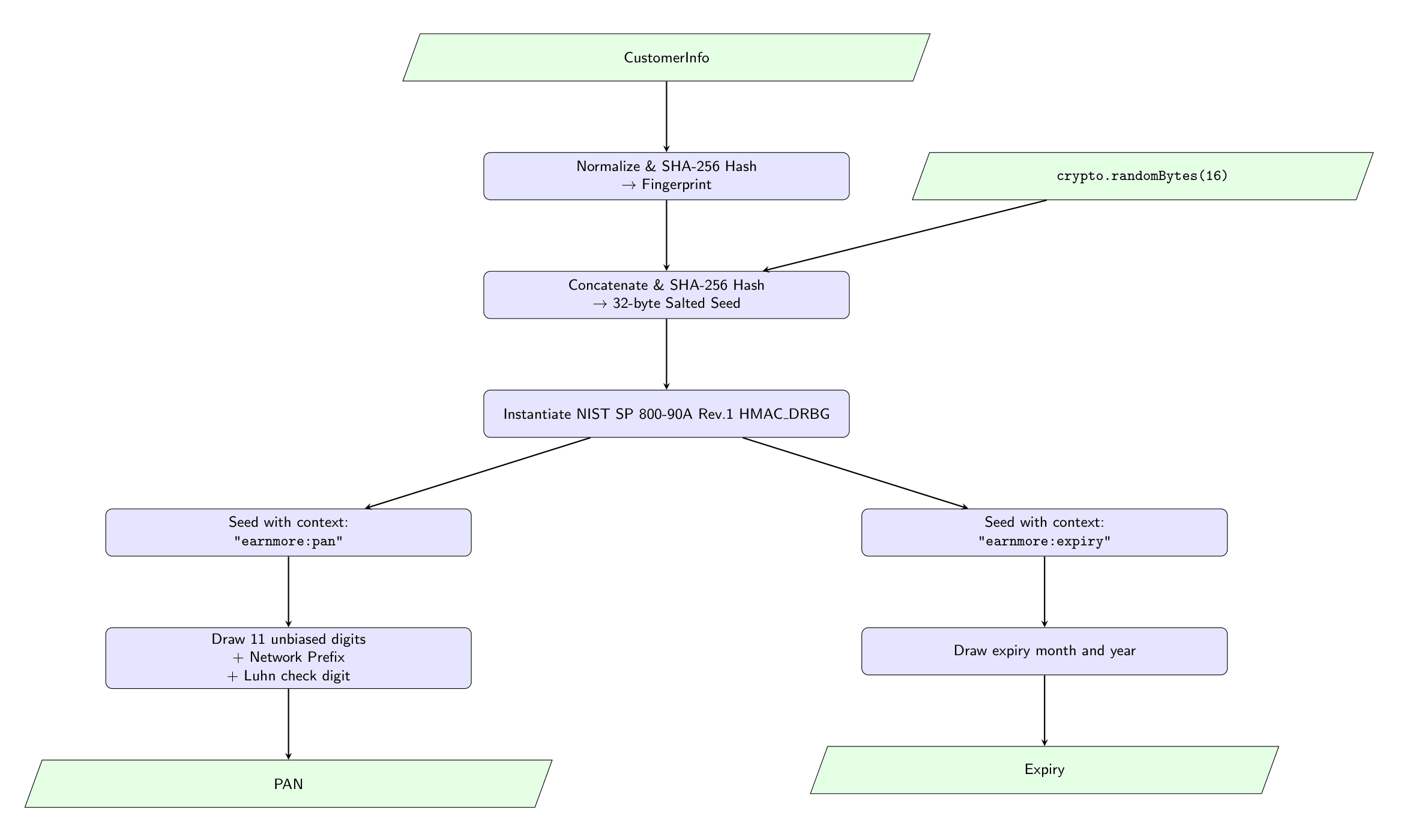
PAN & Expiry Generation (SP 800-90A HMAC_DRBG)
- Fingerprint: The
CustomerInfois normalized and hashed via SHA-256. - Salted Seed:
crypto.randomBytes(16)is concatenated with the fingerprint and hashed again to form a 32-byte seed. - CSPRNG: The formal NIST SP 800-90A Rev.1
HMAC_DRBGstate machine is instantiated with the seed. - Domain Separation:
HMAC_DRBGis seeded with context"earnmore:pan"to draw 11 unbiased digits (via FIPS 186-5 rejection sampling), combined with a network prefix and a calculated Luhn check digit. A completely separateHMAC_DRBGinstance is seeded with"earnmore:expiry"to draw the expiry month and year.
CVV Generation
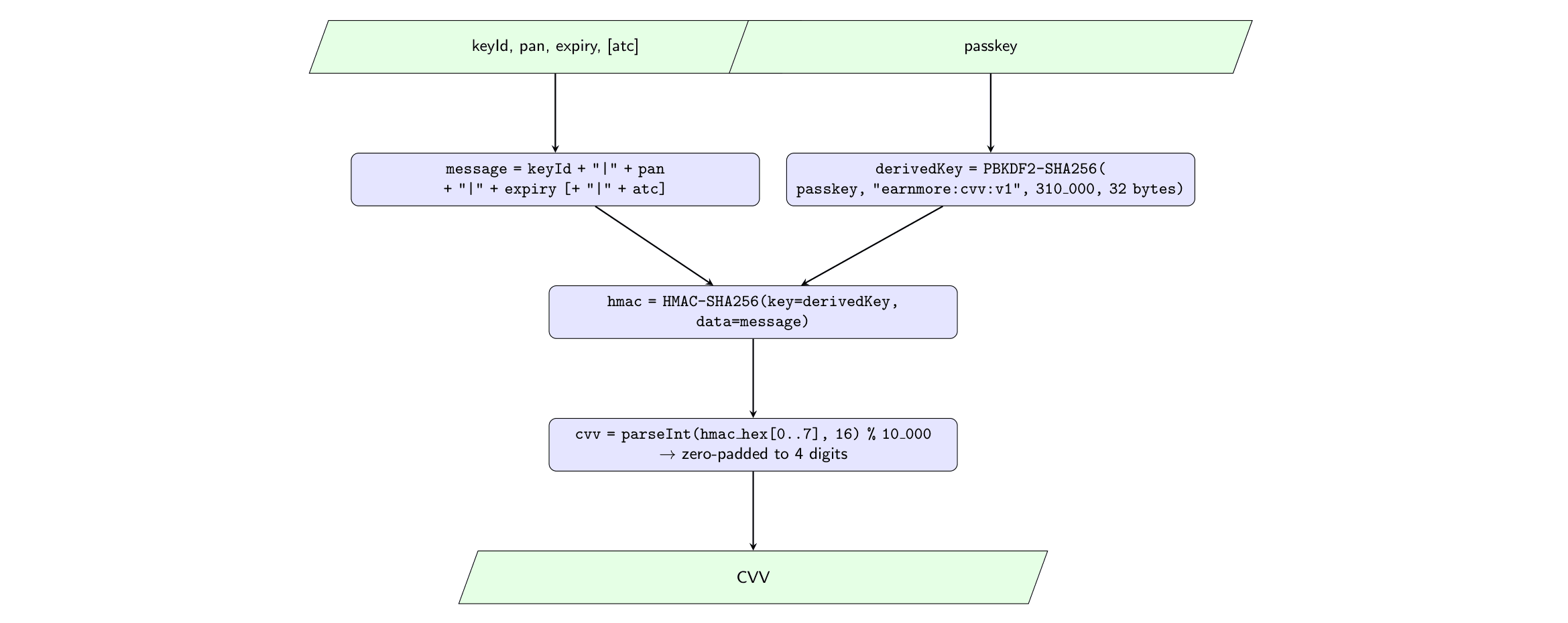
- Key Derivation:
PBKDF2-SHA256is applied to the secretpasskeyusing the domain-separated salt"earnmore:cvv:v1"and a minimum of310,000iterations to derive a secure32-byteHMAC key. - Message Construction: The core message payload is constructed by concatenating the
keyId,pan, andexpiry(and optionally an Application Transaction Counter,atc), each separated by a pipe"|"delimiter. - HMAC Application: An
HMAC-SHA256signature is computed over the message payload using the derived PBKDF2 key. - Truncation and Padding: The first 4 bytes (8 hex characters) of the resulting HMAC digest are converted to an integer, a modulo of
10,000is applied, and the output is zero-padded to generate a mathematically uniform 4-digit CVV.
Key Check Value (KCV)
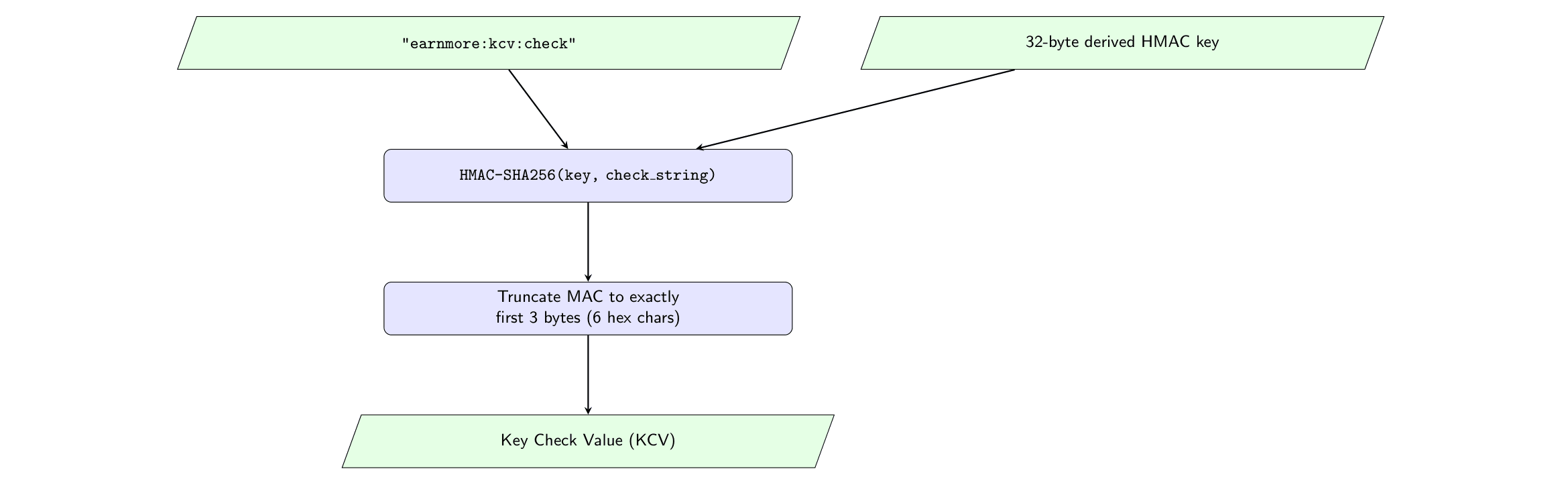
- Constant Definition: A standard deterministic check string
"earnmore:kcv:check"is defined as the input material. - HMAC Calculation:
HMAC-SHA256is calculated over the check string using the 32-byte derived HMAC key. - Truncation: The resulting Message Authentication Code (MAC) is truncated to exactly the first 3 bytes (6 hexadecimal characters) to formulate the KCV.
- Validation: This securely allows systems to verify key rotation and parity across environments (conceptually similar to ISO 11568-2) without exposing or leaking any underlying key material.
PAN Storage & Encryption (AES-256-GCM)
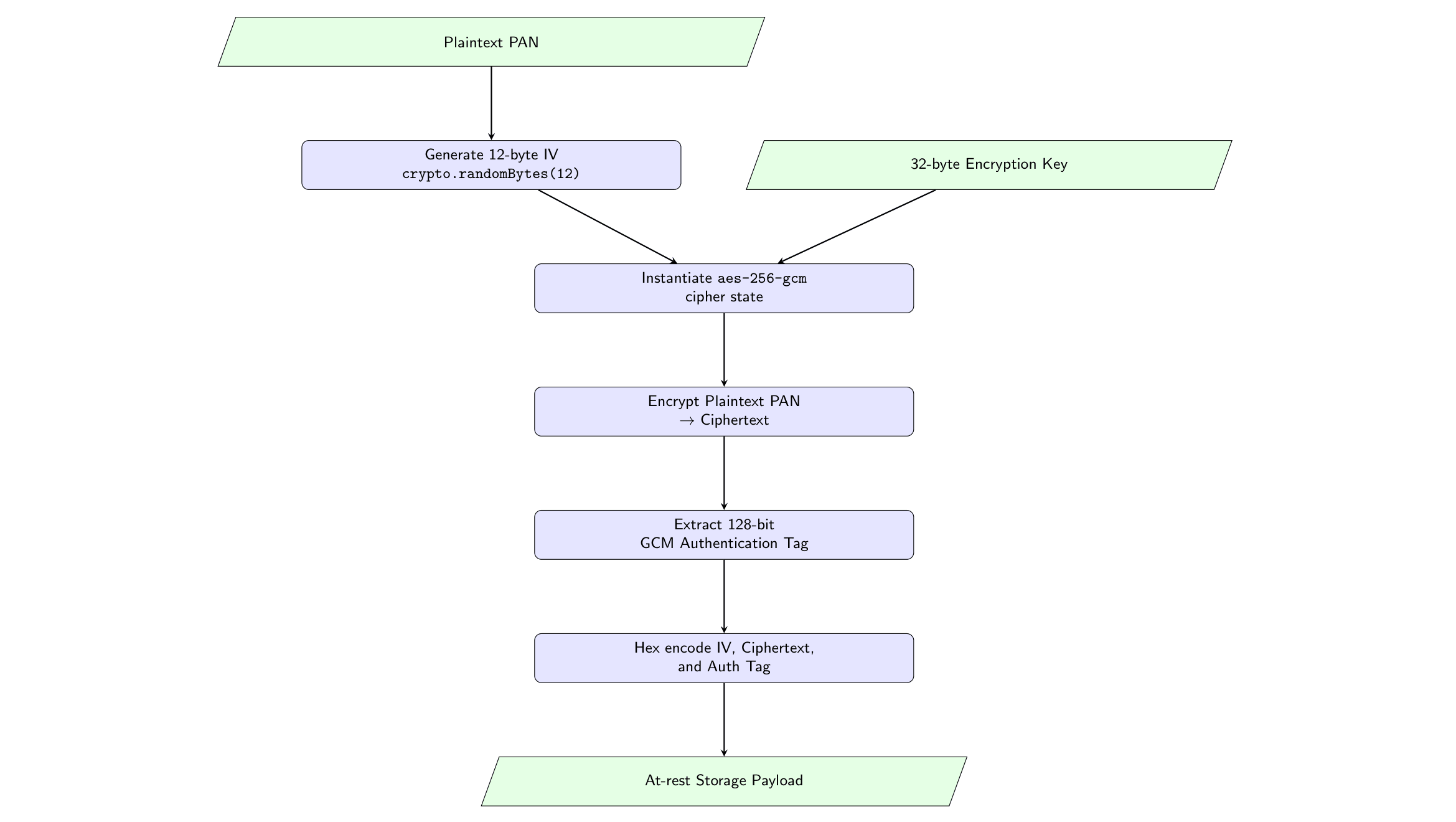
- Initialization Vector (IV): A cryptographically secure 12-byte (96-bit) IV is generated dynamically via
crypto.randomBytes(12)per NIST SP 800-38D recommendations. - Cipher Setup: The
aes-256-gcmcipher is instantiated utilizing a strict 32-byte encryption key (cryptographically separated from the CVV passkey) alongside the generated IV, enforcing a 16-byte authentication tag length. - Encryption: The plaintext PAN string is securely encrypted into ciphertext.
- Integrity Tagging: The 128-bit GCM authentication tag is extracted from the cipher state to guarantee future decryption integrity.
- Storage Formatting: The IV, Ciphertext, and Auth Tag are encoded as hexadecimal strings and returned for compliant at-rest storage satisfying PCI-DSS Req 3.4.1.
PAN Masking & Redaction
- Format Validation: The input PAN is strictly validated via regex to ensure it consists of exactly 16 numeric digits.
- Display Masking: The PAN is spliced into three discrete segments: the first 6 digits (Bank Identification Number / BIN), a hardcoded 6-character mask (
"xxxxxx"), and the last 4 digits. This satisfies PCI-DSS Req 3.5 display masking constraints. - SAD Redaction: During object generation, Sensitive Authentication Data (SAD)—namely the CVV—is explicitly dropped and omitted from the return payload structure. Only non-sensitive Cardholder Data (CHD) is returned, enforcing strict compliance with PCI-DSS Req 3.3.1.

CVV & dCVV Validation
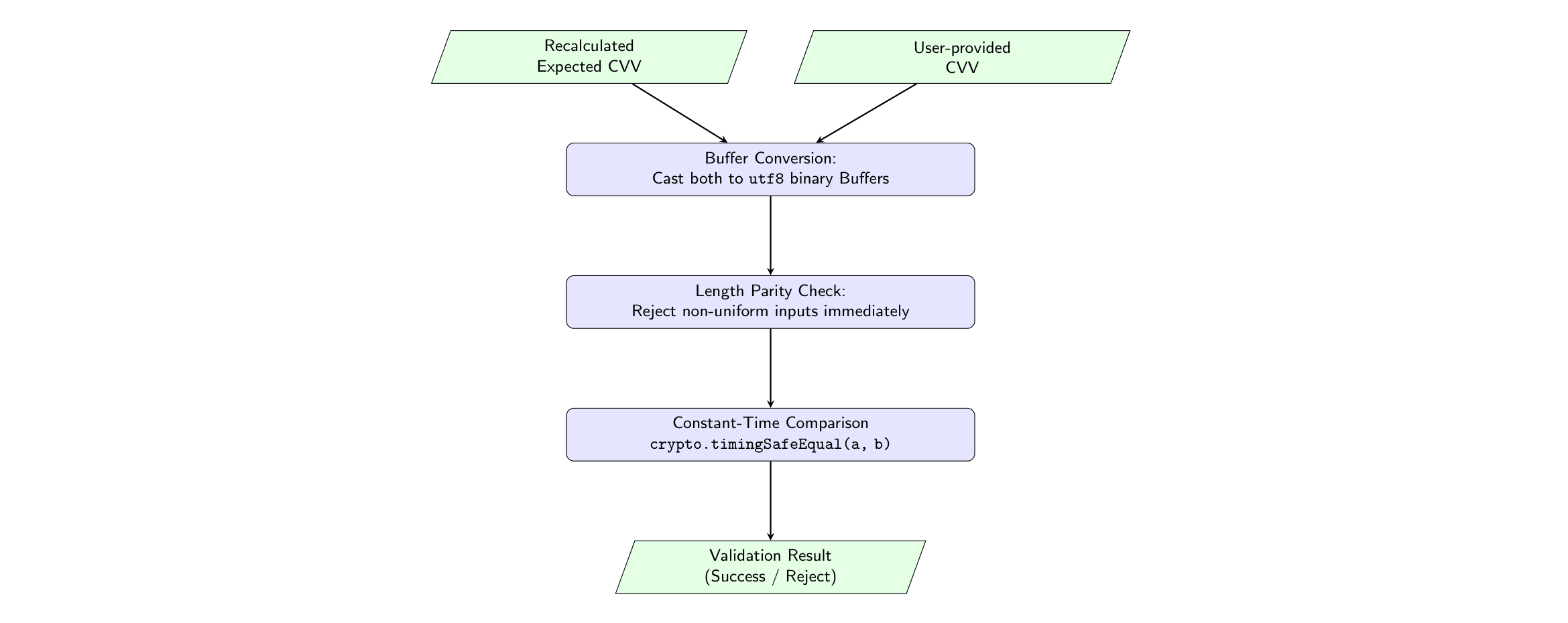
- Recalculation: The library recalculates the expected CVV dynamically utilizing the identically derived PBKDF2 HMAC key, original PAN, Expiry, and (if dynamic) the ATC.
- Buffer Conversion: Both the recalculated CVV and the user-provided CVV are strictly cast into
utf8binary Buffers. - Length Parity Check: An immediate length parity evaluation is performed to reject non-uniform inputs prior to deeper analysis.
- Constant-Time Comparison:
crypto.timingSafeEqual(a, b)enforces byte-for-byte comparison strictly in constant time, completely eliminating susceptibility to cryptographic timing side-channel attacks.
PAN Decryption & Integrity (AES-256-GCM)
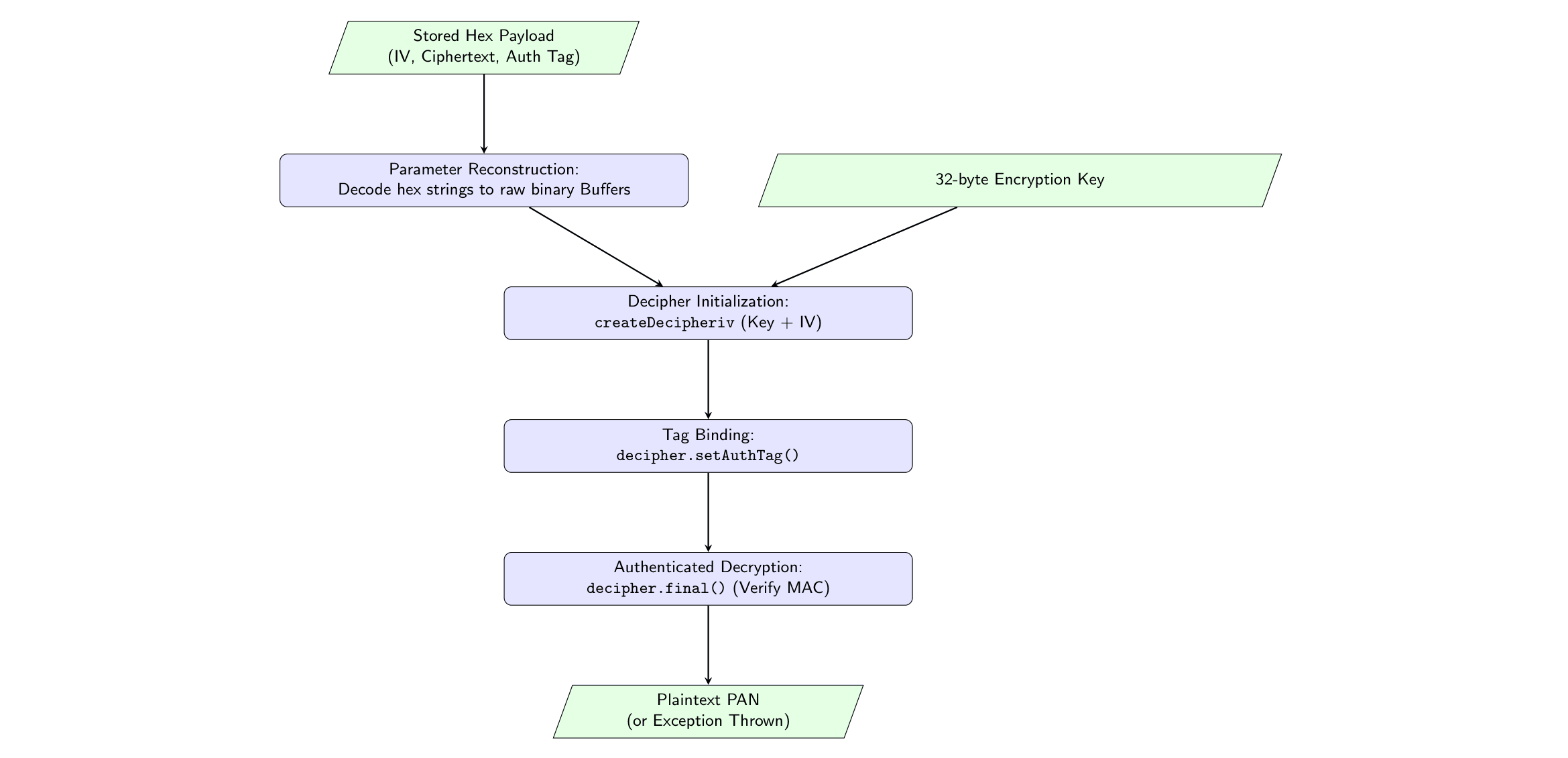
- Parameter Reconstruction: The stored IV, Ciphertext, and 16-byte GCM Auth Tag are decoded from their hexadecimal string representations back into raw binary Buffers.
- Decipher Initialization: A
createDecipherivexecution context is provisioned utilizing the active 32-byte encryption key alongside the retrieved IV. - Tag Binding: The expected authentication tag is explicitly bound to the decipher engine via
decipher.setAuthTag()prior to any decryption operations. - Authenticated Decryption: During
decipher.final(), the GCM polynomial MAC is mathematically verified. If cryptographic tampering or corruption is detected, an exception is aggressively thrown and absolutely no plaintext PAN data is exposed into memory.
Key Rotation & Versioning
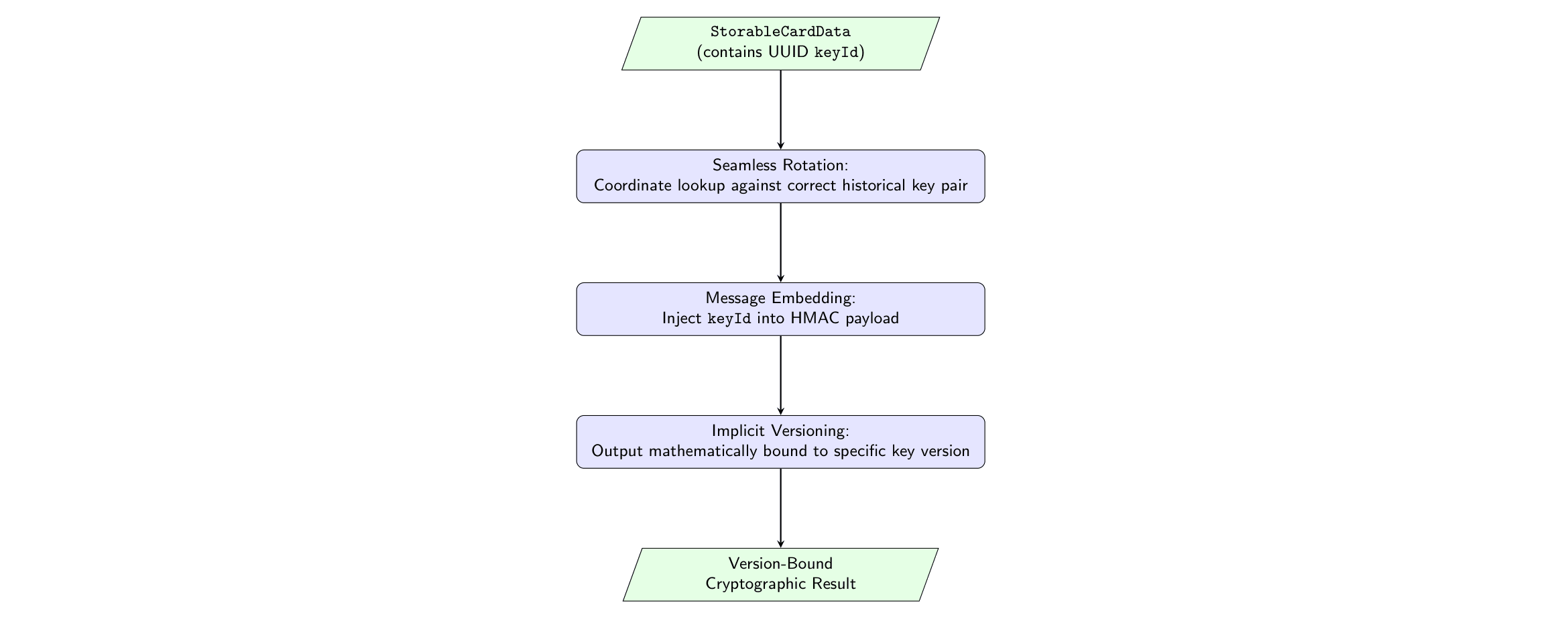
- UUID Binding: All core cryptographic operations rigidly require a
keyIdparameter, fundamentally enforced as a valid UUID. - Message Embedding: The
keyIdis natively injected into the HMAC message payload (e.g.,message = keyId + "|" + pan + ...). - Implicit Versioning: Because the
keyIdcontributes heavily to the resulting HMAC digest, any generated CVV is permanently mathematically bound to the specific key version that originally issued it. - Seamless Rotation: To safely rotate keys, consuming systems merely provision a new key/keyId pair. The library consumes the
keyIddirectly from the user'sStorableCardDataobject to effortlessly coordinate lookups against the correct historical key for decryption or validation routines.
Development
# Install dependencies
npm install

# Build
npm run build

# Run tests
npm test

# Run tests with coverage
npm run test:coverage
Allowed BIN Prefixes
| Prefix | Description |
|---|---|
0011 | Network range A |
9212 | Network range B |
0513 | Network range C |
8989 | Network range D |
7312 | Network range E |
9876 | Network range F |